
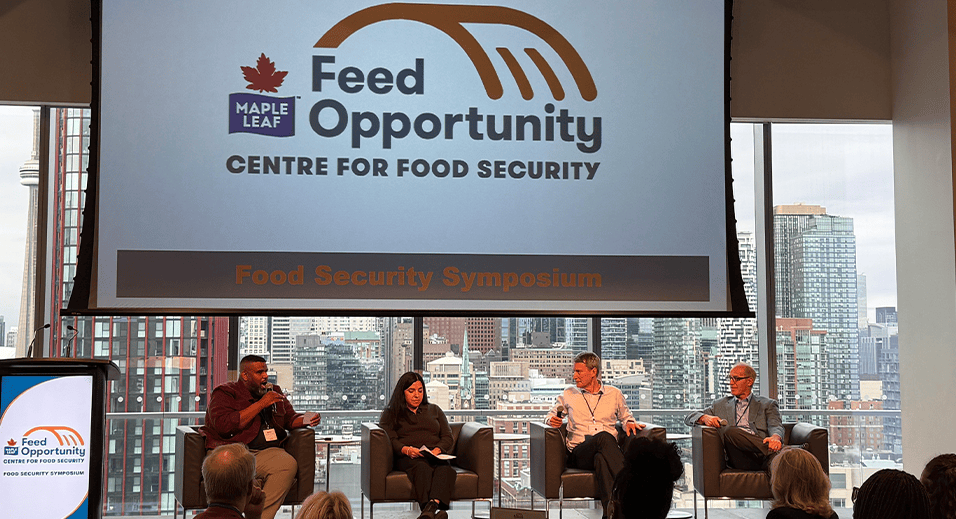
The Maple Leaf Centre for Food Security's sixth annual Symposium explored what it will take to turn promising solutions into action.
By Sarah Stern, Executive Director, Maple Leaf Centre for Food Security
Ten years ago, the Maple Leaf Centre for Food Security (the Centre) was created with an ambitious goal: to advance sustainable solutions and work collaboratively to reduce food insecurity by 50% in Canada.
And this year, as we welcomed more than 160 leaders to join our 2026 Food Security Symposium, I found myself reflecting on how far we've come. The world has changed tremendously in so may ways. Yet the challenge of food insecurity has not — it is actually a much bigger crisis today.
In Canada, 10 million people face food insecurity every day, including one in three children. Black and Indigenous communities are among those disproportionately affected, and 50% of people aged 15 and up who are living in a food-insecure household have a disability. Those numbers are staggering.
This year’s Symposium shone a spotlight on the fact that food insecurity doesn’t just affect how people eat. It affects their health, well-being, and how long they live. That connection between reducing food insecurity and improving health was at the heart of our day together.
The Connection Between Food Insecurity and Health
Food insecurity is fundamentally an income issue. When housing, utilities, transportation, medications, and other necessities consume a household’s income, there’s less leftover for food.
But the consequences extend much further. The health impacts are devastating. It is linked to higher rates of diabetes and cardiovascular disease. For people in Canada living with severe food insecurity, life expectancy is reduced by an average of 9 years. That means lost potential, lost time with loved ones — a life less lived than it could have been. Food insecurity also costs all of us. Severely food insecure adults suffer from poorer health, which generates twice as many costs within the healthcare system as food secure adults.
Throughout the day, we explored opportunities to increase nutritious food for people experiencing food insecurity, particularly when they are also managing health conditions.
Keynote speaker, Dr. Dariush Mozaffarian, Director of the Food is Medicine Institute at Tufts University, challenged us to think about food differently: “Food is medicine is about making food an integral part of how we think about health.”
Food Is Medicine interventions, including produce prescriptions and medically tailored food, were an important part of the conversation. These interventions can both reduce food insecurity and improve health, but the tension exists that they aren’t a replacement for addressing the inadequate incomes that drive food insecurity.
That distinction matters.
If people are arriving in our healthcare system with health issues driven or intensified by food insecurity, we should be asking two questions: How can we support their health today, and how can we prevent food insecurity from contributing to poor health in the first place?


Promising Solutions Are Already Taking Shape
What intrigued me most was seeing how organizations are tackling the connection between food insecurity and health in very different ways.
One approach that's gaining momentum is Food Is Medicine, the idea that food and nutrition can play an important role in improving health. Food prescribing puts that idea into practice through interventions such as produce prescriptions and medically tailored groceries and meals, helping people access nutritious food as part of their health care plan.
As an example of this, we heard about the food prescribing program at the U.S. Department of Veterans Affairs, leveraging the Fresh Connect card to provide veterans experiencing food insecurity with funds to purchase nutritious food, alongside support from dietitians. It showed us what can happen when access to food is more closely integrated with healthcare.
And here in Canada, organizations including the Guelph Community Health Centre, FoodShare Toronto, and Type Diabeat-It shared different approaches to helping people access nutritious food, with or adjacent to health care centres, in ways designed around the realities of the communities they serve. The concept of food prescribing was only the start of the conversation. We also explored reaching people experiencing food insecurity before they land in the health care system. We heard about programs that put more money for nutritious food directly into people's hands, including Carrefour Solidaire Community Food Centre’s Carte Proximité in Quebec, Fred Victor’s food security programming in Toronto, and an initiative delivered through family resource centres in Newfoundland and Labrador.
Across these different approaches, a few principles kept surfacing: dignity, choice, trust, and community involvement. Whether support comes through healthcare, a food prescription, or a broader food benefit, it needs to reflect the needs and experiences of the people it is intended to serve.
As Dr. Elisa Levi, physician and founder of Noongwa Wellness, told us, “We have to invite those to the table who are most impacted by the decisions we're making on broad systems.”
From Promising Programs to Lasting Change
One question became a common thread throughout the day: We know promising approaches exist, but how can we make them last?
Many programs continue to operate through pilots, short-term grants, charitable dollars, or a patchwork of funding. Pilots help us learn. Evidence matters. But people experiencing food insecurity don't live their lives in pilots. And we do have a lot of evidence on what makes a difference.
We need to accelerate action and scale.
That will require government, healthcare, community organizations, researchers, philanthropy, and businesses to all work together.
But the challenge now is turning that knowledge into action.
We Must Build It Together
Ten years into the Centre's work, I'm deeply concerned that so many people across Canada still struggle to afford food.
We know more, and we have promising approaches to build from. And we are excited and hopeful on our next steps — turning that knowledge into meaningful, lasting action that reduces food insecurity and helps people live healthier lives.